Modern Treasury Is Taking Steps to Become a Bank

Hey Digital Banking Fanatic!
What happens when a payments infrastructure company decides to add its own regulated banking layer?
That’s what Modern Treasury is exploring. The company has applied to the OCC to establish Modern Treasury National Trust Bank, a federally regulated, limited-purpose national trust bank focused on digital asset custody and related fiat services.
If approved, the bank would give Modern Treasury customers a unified way to custody and move stablecoins and fiat, bringing those capabilities closer to the company’s existing payments and settlement infrastructure. It would not make loans or issue stablecoins, and Modern Treasury’s existing payments business would continue separately.
The timing is interesting. Modern Treasury says its platform has already powered more than $600 billion in payments for hundreds of organizations, and it now wants to add federally supervised digital asset custody to that infrastructure.
The application still needs OCC approval, so this is not a new bank just yet. But it shows how the boundaries between payments, banking and stablecoin infrastructure are continuing to blur.
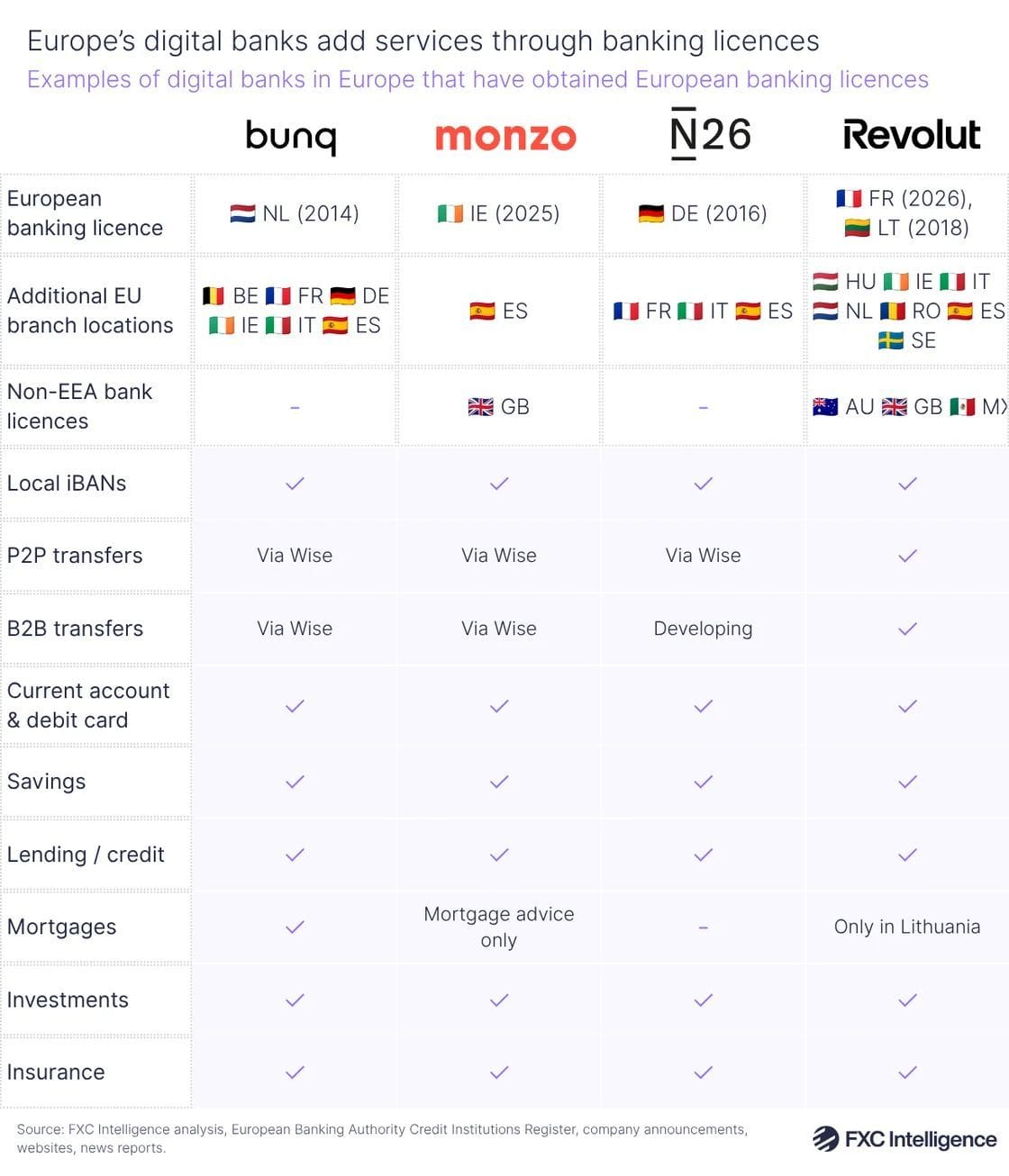
And that brings up another question: what actually separates bunq, Monzo, N26 and Revolut when they now offer almost the same products? The licence is only the beginning. Mortgages are a good example of how differently they build around it.
Here’s what else is happening in digital banking today👇
See you tomorrow!
Cheers,
INSIGHTS
💡What actually separates bunq, Monzo, N26 and Revolut when they now offer almost the same products? The difference is what happens after they get the licence - which markets they enter, which products they build, and how much they keep in-house. Mortgages make that gap pretty obvious. Getting the licence is one thing. Building a full banking proposition around it, country by country, is another. The comparison below gives a good overview. 👇
NEWS
🇨🇦 Knot is now powering card switching for KOHO, one of Canada's largest neobanks with more than 2.5 million customers. KOHO users can add their prepaid Mastercard to the places they already shop in a few taps without leaving the app. The launch continues Knot's expansion in Canada.
🇺🇸 Modern Treasury applies to establish a national trust bank. The proposed bank would add federally supervised digital asset custody to its payments platform. Operations cannot begin until the OCC grants final approval.
🇬🇧 Revolut has started rolling out personal loans to UK customers, offering unsecured borrowing to eligible existing users. Loans range from £2,000 to £25,000 with repayment terms between one and five years. Availability still varies while the rollout continues, and customers can check their eligibility by searching for personal loans in the app.
🇳🇱 Mollie has relaunched Pay by Bank, built on the open banking technology of GoCardless, which it acquired earlier this year. The product combines direct connections to more than 2,500 banks with Mollie's checkout, completing payments in three steps instead of five. It supports single payments, recurring payments and invoicing from the same technical foundation.
🌎 Hyland joins the Jack Henry FinTech Integration Network to link core banking and governed content. The program gives Hyland access to Jack Henry's technical resources. It supports existing OnBase integrations with SilverLake and Symitar Episys.
🇺🇸 Versana's digital loan voting platform is live. Five top agent banks have subscribed, led by J.P. Morgan, Morgan Stanley and Bank of America. The tool automates amendment voting across the $9 trillion loan asset class. Keep reading
Trusted reach among senior decision-makers in FinTech, Payments & Banking.
👉 Explore Partnership here